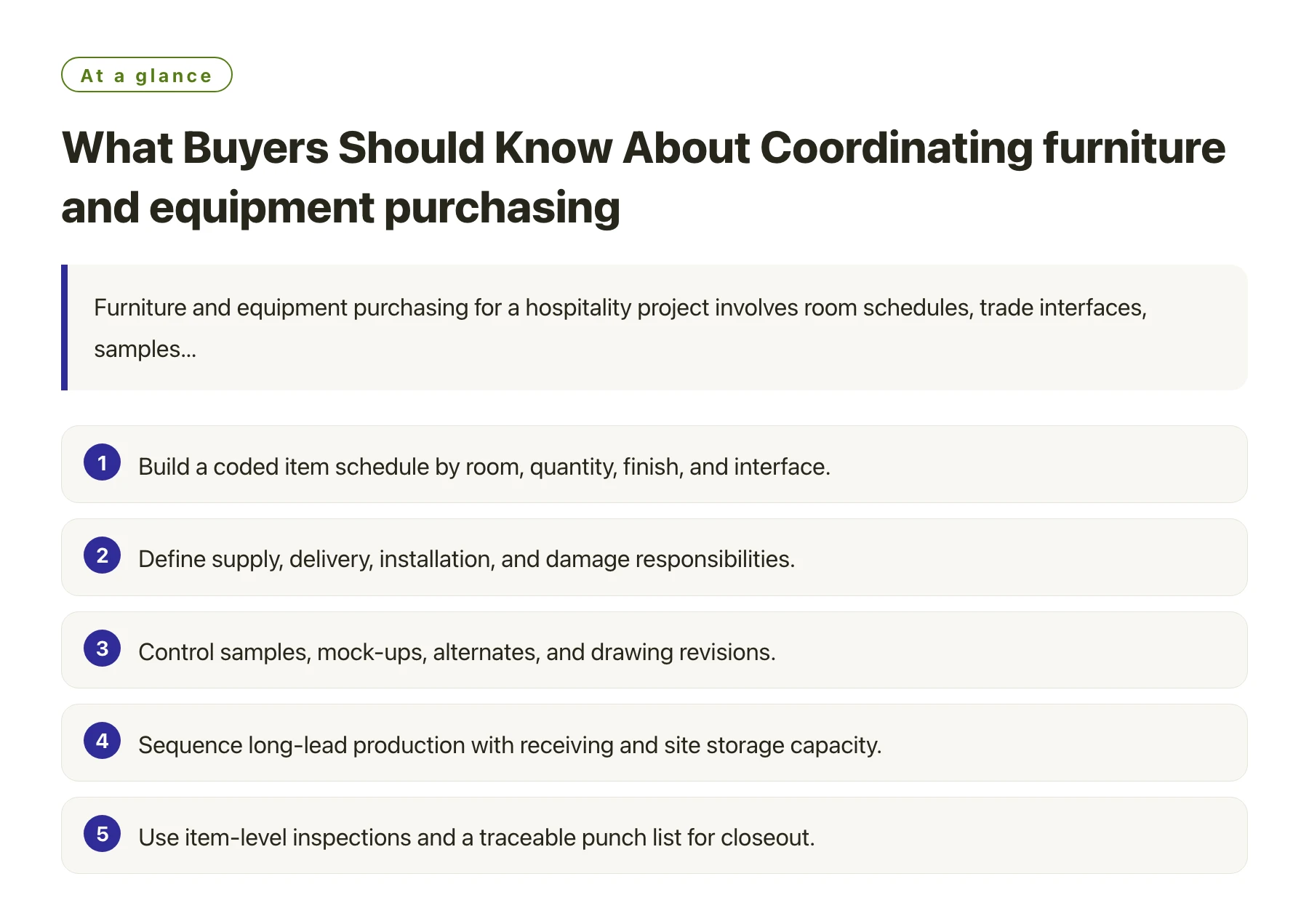
Furniture and equipment purchasing for a hospitality project involves room schedules, trade interfaces, samples, commercial scope, shipment sequencing, and installation handoffs. Buyers can reduce avoidable rework by assigning each item a code, an approval owner, and a delivery path tied to the project drawings and handover dates.
Key takeaways
- Build a coded item schedule by room, quantity, finish, and interface.
- Define supply, delivery, installation, and damage responsibilities.
- Control samples, mock-ups, alternates, and drawing revisions.
- Sequence long-lead production with receiving and site storage capacity.
- Use item-level inspections and a traceable punch list for closeout.
A project may involve dozens of product types, several suppliers, and multiple installation trades. A shared schedule turns those moving pieces into clear package responsibilities.
Build the schedule around rooms and interfaces
Begin with the room list, approved drawings, and opening or handover dates. Assign each furniture or equipment item a unique code and identify room, quantity, dimensions, finish, power or plumbing needs, mounting method, and responsible trade. A room-by-room schedule helps teams see whether a bedside unit, lighting control, headboard, desk, or appliance needs to coordinate with another package.
Mark interfaces early: wall backing, outlet locations, data connections, floor boxes, clearances, door swings, access panels, and maintenance access. Have the architect, engineer, operator, and relevant contractor confirm these details. A supplier drawing is useful input, but it should not silently replace the project’s approved dimensions or technical design.
Split the procurement into packages only after considering shared finishes, installation sequence, compatible hardware, and delivery logistics. One vendor may supply several related items, while another may specialize in a custom piece. Keep the schedule clear about which party provides each item, accessory, fixings, templates, and installation support.
Set commercial boundaries and ownership
For each package, define supply-only, delivery, installation, commissioning, removal of packaging, and after-sales responsibilities. State the point at which risk and custody pass, who coordinates site access, and which party handles damage or missing components. Ask bidders to list exclusions and assumptions next to the relevant line item.
Use a common pricing basis for comparison. Separate product price, customization, samples, tooling, packing, inland transport, freight assumptions, installation, taxes or duties where applicable, spares, and warranty support. Show alternates separately and specify what they change. This prevents an apparently lower package from omitting a required component or service.
Procurement can span need definition, sourcing, negotiation, contract, and supplier relationship management; CIPS describes these as activities across a procurement cycle.[1] Assign a named owner for each handoff so design clarifications, approvals, and commercial changes reach the right decision-maker.
Control samples, finishes, and mock-ups
Create a finish schedule with approved material, color, sheen, texture, edge, stitching, hardware, and cleaning expectations. Identify the sample that governs production and label it with item code, supplier, date, and revision. For natural or printed materials, define acceptable variation using a representative range rather than one small swatch.
A room mock-up can expose conflicts between furniture, lighting, controls, circulation, and housekeeping before a full order is made. Define the mock-up scope, review participants, punch list, and sign-off authority. Record the changes by item and drawing revision. A verbal approval in a walkthrough can be misunderstood when production teams later work from old files.
If a bidder proposes an alternate fabric, finish, dimension, or hardware, compare its maintenance, durability, appearance, lead time, and interface effects. Keep approved alternates distinct from the base specification and require written acceptance before purchase release.
Coordinate lead times, storage, and installation sequence
Request realistic production milestones for long-lead and custom items. Include design freeze, sample approval, material procurement, production, inspection, packing, dispatch, arrival, storage, and room installation. Ask suppliers to flag dependencies and give early notice of material or capacity constraints instead of reporting a delay only at the dispatch date.
Match shipment lots to the site plan. Decide whether goods should arrive floor by floor, room by room, or as consolidated packages. Confirm available receiving space, lift and corridor dimensions, unloading windows, protection requirements, and storage conditions. Avoid sending fragile or moisture-sensitive items to a site that cannot receive or protect them.
Define the sequence with the general contractor and installers. Establish who checks room readiness, receives cartons, distributes items, assembles or anchors units, removes packaging, and signs off damage. If work must occur around other trades, list access rules and protection measures in the schedule.
Inspect the deliverables and close the package
Set review points for approved shop drawings, first article or sample, in-process status, pre-shipment checks, delivery, and installation completion. The inspection criteria should match the item: dimensions, finish, hardware, function, quantity, labels, and package condition. Identify sample basis and what the inspector cannot verify so the report does not imply a wider review.
Use a punch list that records item code, room, location, condition, photograph, responsible party, correction date, and closure evidence. Separate cosmetic observations from safety or functional concerns and assign priority with the project owner. Retain spare parts and maintenance information in an indexed handover pack.
For Shanghai JS Sourcing, hospitality buyers can define whether the requested support covers supplier research, quote coordination, samples, production communication, or inspection planning. Keep package scope, approval authority, reporting schedule, and pass-through charges in writing, and align them with the project’s design and installation teams.
Sources
Frequently asked questions
When should furniture and equipment packages be divided?
Divide them after reviewing related finishes, interfaces, installation sequence, supplier capability, and delivery logistics so package boundaries do not leave items or responsibilities unassigned.
What belongs in an item schedule?
Include a unique item code, room or zone, quantity, dimensions, finish, connections, mounting needs, accessories, supplier package, and approval status.
Who should approve a room mock-up?
Name the design and operational reviewers in advance, record comments by item and revision, and identify the person authorized to sign off changes.
How can a project reduce delivery problems?
Align shipment lots with site readiness, storage capacity, access windows, room sequence, receiving ownership, and installation responsibilities.