The sample a brand approves and the bulk that arrives months later are made in different rooms, at different scale, often by different people, and from materials that have aged by different amounts. That gap is not a manufacturing defect; it is the normal condition of scaling, and it is closed by a handover process rather than by hope. Brands that plan the handover points in advance get bulk that matches the reference, and they can prove it when it does.
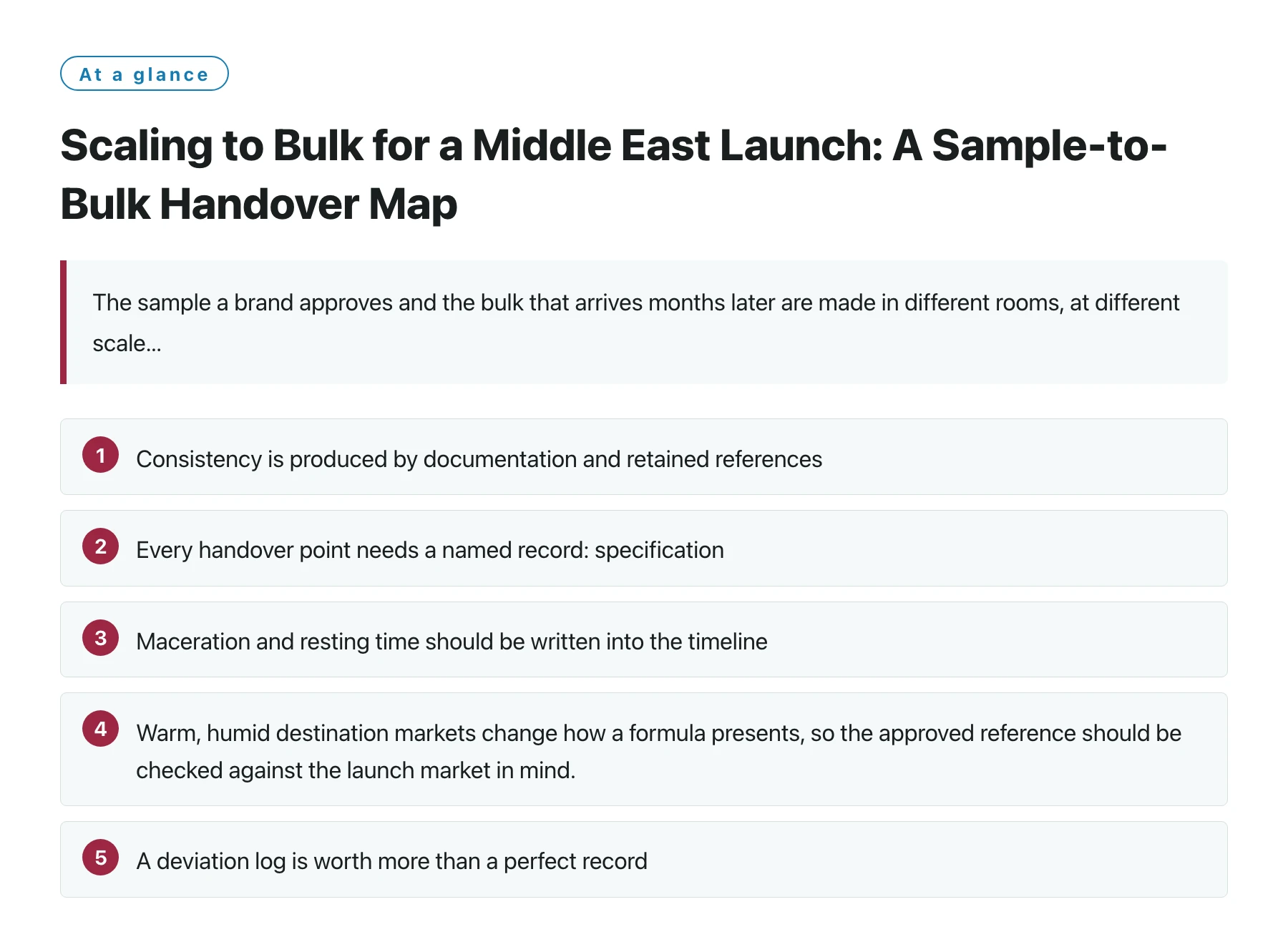
Key takeawaysConsistency is produced by documentation and retained references, not by the perfumer remembering what was approved. · Every handover point needs a named record: specification, retained sample, batch sheet, fill record and release note. · Maceration and resting time should be written into the timeline, because a bulk batch assessed too early reads differently from the approved sample. · Warm, humid destination markets change how a formula presents, so the approved reference should be checked against the launch market in mind. · A deviation log is worth more than a perfect record, because it shows how the factory behaves when something changes.
A brand approves a sample in a meeting room, signs it off by email, and waits. Weeks or months later a pallet arrives. Between those two moments sits a chain of small decisions: which material lot is used, how long the compound rests, how the fill weight is verified, how the bottles are stored, how the batch is compared against the approved reference.
Most of those decisions are reasonable in isolation and can still add up to a product that reads differently from the sample. The purpose of a handover map is not to remove judgement from the process; it is to make each decision visible and recorded, so that when a difference appears the cause can be found instead of argued about.
This is the sequence that works when the destination is a Middle East launch, where heat, humidity and long transit times put extra weight on the handover stage. The map below is one a brand can hand to any partner, whether that partner is Xuelei custom perfume or a shortlist of several houses.
Why the handover, not the sample, decides consistency
A sample is a small batch made under close attention, sometimes compounded by the person who designed the formula. Bulk is a larger batch made to a sheet, possibly by a different team, with materials drawn from different lots. Scaling changes the surface-to-volume ratio of mixing, the order in which materials are added, and how much time the compound spends resting before filling.
None of this is a secret inside a factory, and none of it is a problem when the process is written down. The failures that reach brands usually come from the same three places: an approved reference that was never retained, a specification that describes the scent in adjectives rather than in measurable terms, and a timeline that leaves no resting period before filling.
Sorting those three out at the handover stage is far cheaper than sorting them out after the goods are on a ship. It also gives both sides something to point to if a batch is challenged later.
What the approved reference actually is
An approved reference is not the first sample that pleased the buyer. It is a retained, sealed quantity of the final approved formula, stored under controlled conditions, identified by batch or compound code, that both sides hold a copy of. Bulk is judged against it, not against anyone's memory of the meeting.
Aroma materials continue to change in the bottle through evaporation and oxidation [1], which is one reason the reference has to be stored properly and replaced periodically. A reference kept on a sunny shelf is not a reference; it is a second variable.
Seven handover points from approved sample to bulk
- Signed specificationThe approved formula recorded in writing with the compound code, the concentrate load, the carrier and any functional additions. Adjectives can appear as context; the numbers are the specification.
- Retained reference sampleSealed and labelled copies held by the factory and the brand, stored under the same conditions, with a note of the date and the storage location in both files.
- Material lot declarationConfirmation of which lots of the key aroma materials will be used for the bulk compound, and what the factory does if a lot differs from the one used in sampling.
- Maceration and resting planThe number of days the bulk compound rests before filling, written into the timeline rather than decided on the day. This single line prevents a large share of sample-versus-bulk complaints.
- Fill and packaging recordFill weight, bottle lot, closure torque where relevant, decoration confirmation and an agreed sampling plan across the batch rather than at the start of the run.
- Destination checkA release test that reflects the launch market, so a product designed for warm, humid conditions is assessed in that context rather than only at the factory bench.
- Release note and deviation logOne page stating what was produced, what differed from plan and what was done about it. The deviations are often the most valuable part of the record.
Where a Middle East launch changes the handover
The handover sequence is the same everywhere; the emphasis shifts with the destination. For a Middle East launch, a bulk batch travels further and often sits in higher temperatures in transit and in the warehouse. Two additions are worth making to the standard handover.
First, add a transit and storage note to the packaging specification. If the decoration is sensitive to heat or humidity, or if the secondary packaging will be stored uncooled for weeks, that belongs in the record before the run rather than in a complaint after delivery. Second, agree how the product will be assessed on arrival: whether the factory's release test is the final word or whether the brand will run its own check against the retained reference.
Both items cost a paragraph in the handover document and remove an entire category of late dispute. They are also the two items most often missing from a first order, because the brand is focused on getting the scent right and treats logistics as somebody else's file.
Making the process visible across the range
A brand with more than one product in development should not run a separate handover for each item. The same seven points apply to a fine fragrance, a home fragrance and a scented body product, with the carrier and fill details changed. Standardising the record makes it possible to compare batches over time, which is the only way to tell a one-off difference from drift.
It also makes the relationship easier to manage, because a factory that receives the same structured document every time will mirror it. Any partner handling development and filling as connected work, as with contract perfume manufacturing in China, can usually fold the seven points into its own quality system rather than treat them as customer paperwork.
What the brand side has to do
The handover is not only the factory's responsibility. Three items belong to the brand, and skipping them undermines the rest of the record.
The first is a single named contact who can approve a deviation without a committee meeting. The second is a realistic review window: if the brand needs two weeks to evaluate an arrival sample, that should be in the plan, because a rushed evaluation on arrival day is how small differences get approved or rejected on mood. The third is storage. A retained reference kept in a warm office tells you nothing about how a bulk batch was made.
There is a commercial argument for doing this properly even on a small first order. A brand that can show a consistent batch record when talking to a distributor or a retail buyer is describing a supply chain rather than a single lucky shipment.
When to bring in the development partner
The handover map should be agreed at the same time as the formula, not after the sample is approved. Raising it earlier changes what the factory can commit to: resting time affects the shipping date, and a destination release test affects the sampling schedule. A conversation about perfume manufacturing process at brief stage is what makes the seven points realistic rather than aspirational.
For a first order, the goal is not a perfect quality system. It is one page that both sides have signed, listing what is measured, what is retained and who decides if something differs. Everything after that is refinement.
If a bulk batch smells different from the approved sample, do not begin by asking whether the formula changed. Begin by checking the four items that explain most differences: the retained reference and its storage, the resting period before filling, the material lots used for the compound, and the temperature the product has experienced since filling. In most cases the formula is intact and one of those four has moved. Find which one, fix it in writing, and the next batch has a chance of being better than an argument.
Keeping bulk true on the order after this one
The second order is where consistency is usually tested hardest, because attention has moved on and the people involved may have changed. Two habits carry a brand through that stage: replacing the retained reference on a defined schedule, and comparing each new batch against it rather than against the previous shipment.
Compared against the previous shipment, small differences compound quietly and the product drifts over a year. Compared against a controlled reference, each batch is measured against a fixed point. That distinction is the whole of the handover discipline, and it is available to any brand, at any order size, for the cost of a sealed bottle and a paragraph in the agreement.
Sources
- Chemistry World (Royal Society of Chemistry) —— The Royal Society of Chemistry's magazine, covering chemistry research and explanations of everyday materials including aroma compounds.
Frequently asked questions
How long should a bulk fragrance compound rest before filling?
It depends on the formula and the materials, so the number belongs in the specification rather than in general advice. What matters is that a resting period is written into the timeline before the sample is approved, because adding it afterwards moves the shipping date.
Who should keep the approved reference sample?
Both sides. The factory needs it for release testing; the brand needs it for arrival checks and for the next order. Store both copies under the same conditions and replace them on a set schedule so the reference does not itself age into a difference.
Why does bulk smell weaker than the sample on arrival?
The usual causes are an insufficient resting period before filling, a material lot that differs from the sampling lot, or heat exposure in transit. Compare the arrival batch against the retained reference and work through those three before questioning the formula.
Is a formal handover process necessary for a small order?
Yes, and it costs little. A small order benefits more, not less, because there is no spare stock to absorb a rejected batch. One signed page covering specification, retained reference, resting time and release criteria is enough to start.
Should the brand test the product on arrival?
An arrival check against the retained reference is a reasonable practice, especially after long transit. Agree in advance whether it is advisory or binding, and how a difference would be resolved, so the check does not become a dispute over whose nose is correct.